Vocabulary is an indispensable part of knowledge in the IELTS preparation process. Understanding the importance of this, IELTS Xuan Phi will share with you methods, ways of learning and specialized IELTS vocabulary materials by topic in the article below. Let’s take a look! https://www.citytours.com/tarifarios/
How to start learning vocabulary?
Vocabulary is closely related to IELTS English skills. You need to plan to review vocabulary in detail before applying it to listening, speaking, reading, and writing. Prepare from the simplest things such as notebooks, pens, highlighters, and decorations. The more carefully you prepare, the more motivated you will be to study without being discouraged. From there, you can create a certain calmness and confidence for yourself before taking the test.
In addition, you also need to pay attention when choosing appropriate sources of documents. IELTS Xuan Phi suggests some popular sources as follows:
- Online learning: ebooks, lessons on websites, Youtube, online dictionaries, phone applications.
- Direct learning: hard copy books, paper dictionaries,…
You should know that learning vocabulary is not just about learning a single word but also about learning phrases and understanding how to use them. Below are the important steps to learning vocabulary that you need to grasp.
5 steps to learn IELTS vocabulary to understand deeply and remember for a long time
Step 1: Choose a reading passage according to IELTS topic
In IELTS, there are many topics and fields related to life, society, culture, entertainment,… You can start learning through a topic close to you in the list below.
- Study
- Work
- Marriage and Family
- Gender
- Personal Development
- Movie
- Lifestyle
- Traditions, Modern Life
- Fashion
- Money
- Education
- Environment
- Nature
- Transport
- Tourism
- Travel
- Technology
- Media
- Television, Internet, Mobile Phones
- Advertising
- Celebrities
- Entertainment
- Town and City
- Animals
- Crime
- Guns and Weapons
- Global Issues
- Government and Society
- Health
- Invention
- History
- Emotion
- Sports and Leisure
- Tourism
- Water
So where should we find these thematic readings? Look no further, practice with IELTS readings according to your level. This way, you can do one step and get many results. https://museoicticola.uabjb.edu.bo/ You can both improve your IELTS vocabulary by topic and accumulate a lot of useful knowledge for yourself.
Learn IELTS vocabulary by topic from IELTS test
Step 2: Read through the content and try to guess the meaning of the vocabulary.
An IELTS reading passage consists of smaller paragraphs. You can start with the first paragraph or any paragraph. You do not necessarily have to read the whole passage to avoid confusion if you encounter difficult vocabulary. You should skim the content to have a basis for guessing the meaning and implication of the author.
Short passages are easy. However, if you encounter longer passages, you need to read selectively. Pay attention to keywords that indicate proper names, addresses, places, or key phrases that indicate a certain action.
Step 3: Look up the dictionary
After step 2, if there is any vocabulary that you do not know and cannot guess the meaning, you need to use a dictionary. And looking up an English-English dictionary is the way IELTS Xuan Phi will advise you. Reading the English explanation helps you understand the nature of that vocabulary thoroughly. Moreover, the dictionary also clearly shows the pronunciation, gives examples, and gives synonyms and antonyms of the vocabulary. Thanks to that, you will understand many other factors surrounding a vocabulary.
Step 4: Write vocabulary in your notebook
Looking up a dictionary can only help you understand the meaning at a certain point in time. If you want to remember it longer or don’t want to bother looking up the meaning again, you need to write down the vocabulary in a separate notebook. Arrange and design the vocabulary book layout to make it easy to see and eye-catching. You can use highlighters to mark and draw illustrations. And don’t forget to always give example sentences for vocabulary to understand the specific context.
Step 5: Review regularly
Knowledge will be most deeply imprinted in the mind if practiced many times. The same goes for learning IELTS vocabulary by topic . You need to apply the words you have learned to practice rewriting sentences and practicing speaking according to your thoughts.
You can spend about 30 minutes to 1 hour a day to learn IELTS vocabulary . Every 2 to 3 days, you review and practice until you don’t need to use a dictionary. At this point, you must have successfully turned the words you learned into your vocabulary.

Practicing a skill over and over again will help you become as proficient as possible.
IELTS vocabulary learning materials by topic
Below, IELTS Xuan Phi will introduce to you some IELTS vocabulary learning materials by topic to help you better prepare for your exam.
English Vocabulary in Use
This set of 4 books is suitable for learners at all levels.
- Elementary book for beginners to learn IELTS
- Pre Intermediate & Intermediate for those with a foundation
- Upper Intermediate is suitable for those who want to self-study at the elementary level.
- The Advanced book is aimed at the advanced level.
Each book provides from 1250 to more than 3000 vocabulary words by topic. From the most basic to in-depth academic topics, it is very suitable for reviewing IELTS vocabulary by topic .
English Collocation in Use
The English Collocation in Use document set is suitable for those at IELTS band 5.5 or higher. At this point, learners are relatively confident in their skills and can start learning collocation to supplement. The document is divided into 2 books:
- Collocation in Use Intermediate
- Collocation in Use Advanced.
The books all provide concepts, explain structures and grammar around Collocations . Each lesson is divided into separate topics that can be found in real exams.
Vocabulary for IELTS – Collins
This is one of the familiar IELTS skills training materials for many of you. The material is compiled based on topics corresponding to the 4 IELTS skills tests (listening, speaking, reading, writing). The book is for people at IELTS level 5.0 or higher. The content in the book provides core knowledge through theory, practice exercises and tests. Along with useful tips and advice to help learners consolidate vocabulary firmly.
Cambridge Vocabulary for IELTS
The book provides the most common vocabulary that often appears in the IELTS test. If you already have basic knowledge, you can use this book proficiently. Because in addition to providing knowledge, the book also guides and shares how to do it in English. The book does not have a Vietnamese version, so it will be difficult for those who have no background.
Cambridge Vocabulary for IELTS Advanced
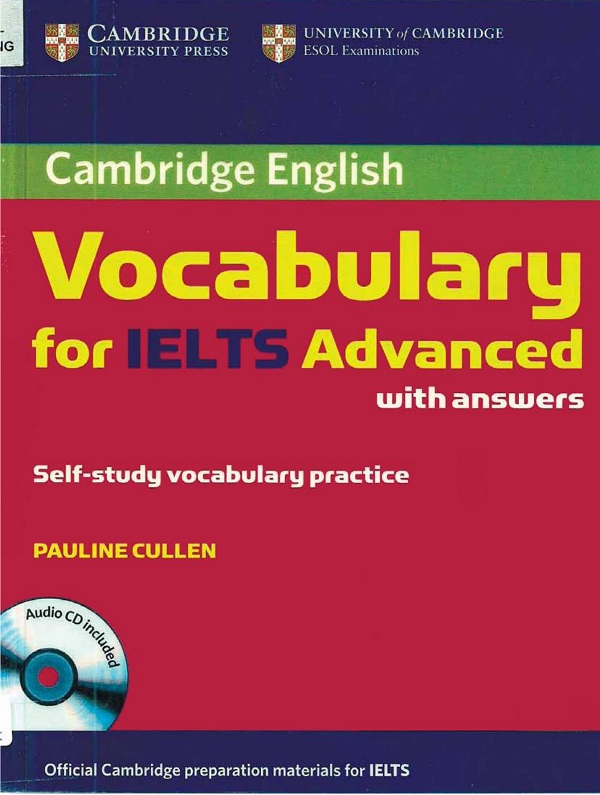
Cambridge Vocabulary for IELTS Advanced
This book is more advanced than the regular Cambridge Vocabulary for IELTS . The book provides many different types of exercises, which are often found in the exam. Such as Multiple choice, True/False/Not given, Yes/No/Not given, Matching information/headings, Form completion,… In addition, each exercise also has an accompanying audio file. You can both learn vocabulary and practice pronunciation every day.
>>> See more: Instructions for using and downloading Cambridge Vocabulary for IELTS || IELTS Reading Vocabulary
Hopefully, the methods and materials of IELTS vocabulary by topic shared above will help you improve your vocabulary more and more every day. Wish you good vocabulary review for the IELTS exam!